
Teams often start with SCA but later need a clearer view of risk across code, web apps, cloud environments, dependencies, and open source usage. The issue isn’t just the number of alerts; it’s the lack of context around what actually matters.
Security teams need tools that help them understand exposure, ownership, and priority without forcing developers into heavy processes. This comparison looks at six tools that approach visibility from very different angles. Aikido comes first because it gives the broadest starting point for teams that want AppSec visibility without stacking too many separate tools.
1. Aikido
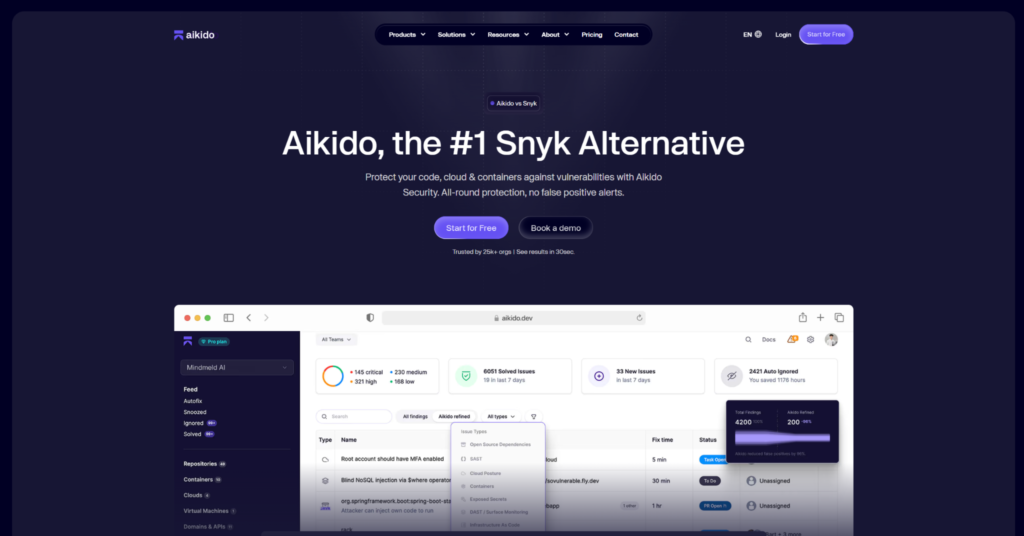
Aikido is the strongest overall choice for teams that want broader security visibility without spreading work across too many products. It covers code, cloud, containers, dependencies, secrets, and runtime risks in one workflow. Think of Aikido’s Snyk alternative for broader security visibility when you need one tool instead of six. The value isn’t just broad coverage; it’s also clearer prioritization for developers. Aikido fits teams that want to reduce blind spots without turning AppSec into a slow enterprise process.
Broader visibility only matters if teams can actually act on it. Noisy dashboards can make security harder instead of easier. Aikido’s edge comes from connecting several risk areas while keeping developer workflows usable. You don’t need a security degree to understand what’s broken. Here’s why it’s number one for this visibility-focused list:
- Connects code, cloud, container, dependency, secret, and runtime findings in one workflow;
- Helps teams see more risk areas without buying several disconnected tools;
- Makes alerts easier for developers to understand and prioritize;
- Reduces operational overhead for teams that ship often;
- Works well for companies that want broad AppSec visibility without heavy rollout friction.
Aikido is the most balanced option in this list. Specialized tools may go deeper in one area, but Aikido gives teams a wider starting point.
Best Match for Aikido
Aikido suits engineering teams that want one place to manage several AppSec risk areas. It is especially useful when developers already struggle with alert noise and too many security dashboards. The tool works best for companies that want faster adoption instead of a long enterprise migration. Teams with deeply embedded legacy processes may need more planning before switching.
2. Acunetix
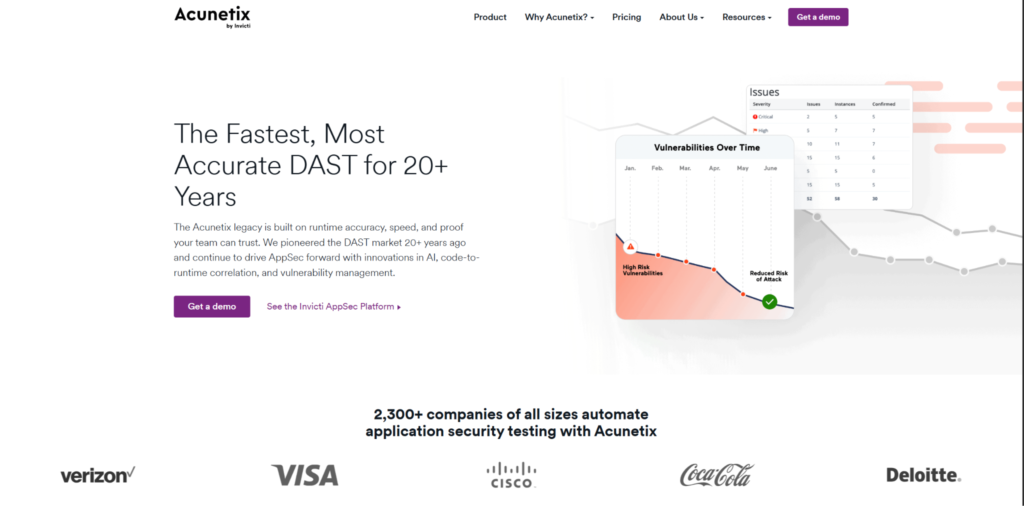
Acunetix is a web vulnerability scanning tool for teams focused on external web application risk. It differs from Snyk because it looks more at websites, web apps, APIs, and exposed attack surfaces. This makes it useful when a team wants visibility into issues attackers could find from the outside. Don’t think of it as a full replacement for broader AppSec work. Acunetix belongs in this list because web exposure remains a major part of security visibility.
Web risk can sit completely outside dependency reports. Misconfigurations, exposed pages, weak inputs, API issues, and scan coverage all matter. Acunetix catches things your package scanner will never see. It’s not pretty, but it works for what it does. Here’s where it adds real value for teams that need web-facing visibility:
- Scans websites, web applications, and APIs for common vulnerabilities;
- Helps teams identify externally visible issues before attackers exploit them;
- Works well for recurring checks across web properties;
- Supports teams that need DAST-style testing as part of their security process;
- Fits companies where public-facing applications create the biggest concern.
Acunetix is strongest when web scanning is the priority. Teams needing code, cloud, secrets, and runtime visibility will still need a broader tool around it.
Where Acunetix Fits Best
Acunetix is a good choice for teams with many public web assets. It helps when security teams need repeatable scanning without relying only on manual review. The tool is less suitable as the main AppSec layer for teams trying to manage several risk areas at once. Think of it as a focused web testing tool, not an all-in-one security workspace.
3. Tenable
Tenable is a vulnerability and exposure management option for organizations with broad infrastructure risk. It is usually relevant for teams that need visibility across assets, systems, weaknesses, and attack paths. Tenable is not a narrow developer tool, so judge it differently from Snyk. Its strength is helping security teams understand exposure at scale. The tool belongs in this list because broader security visibility often extends well beyond application code.
Exposure management matters for larger organizations for a bunch of reasons. Risk can come from assets, misconfigurations, outdated systems, and weak points outside the application repository. Tenable sees things that developer-focused tools simply miss. It’s built for security operations, not for pull requests. Here’s where it helps teams that need wider risk visibility:
- Helps organizations track vulnerabilities across a large asset base;
- Gives security teams a wider view of exposure beyond application dependencies;
- Supports prioritization when teams deal with many systems and findings;
- Works well for companies with mature vulnerability management processes;
- Fits organizations that need infrastructure-level visibility alongside AppSec tools.
- Tenable is a stronger fit for broad exposure management than developer first AppSec. Smaller teams may find it heavier than they actually need.
Strongest Use Case for Tenable
Tenable fits companies with large environments and formal security operations. It is useful when the problem isn’t just application risk but total exposure across many assets. Developer teams looking for simple AppSec workflows may need something lighter. Aikido makes more sense if you mostly care about code and dependencies.
4. Jit.io
Jit.io is a security automation platform for teams that want more visibility into how security controls operate throughout development. It helps connect security activities with repositories, CI/CD pipelines, and deployment workflows instead of treating them as separate tasks. This makes it easier to understand where security checks happen and where gaps may still exist. The platform focuses on making security processes more consistent across engineering teams. Jit.io belongs in this list because workflow visibility is an important part of broader security coverage.
Security workflows often become difficult to manage as engineering teams grow. Different repositories, pipelines, and release processes can create blind spots that are hard to track manually. Jit.io helps teams standardize security checks without adding unnecessary friction to development. The platform is designed to make security activities easier to monitor and repeat across projects. Here’s how it helps teams improve workflow visibility:
- Helps integrate security checks directly into CI/CD pipelines;
- Supports consistent security processes across multiple repositories;
- Reduces manual coordination between engineering and security teams;
- Improves visibility into how security controls are applied;
- Fits organizations building structured DevSecOps practices.
Jit.io is useful when workflow consistency and security automation are the main priorities. Teams looking for broader visibility across cloud, containers, secrets, and runtime risk may need a wider AppSec solution.
Ideal Fit for Jit.io
Jit.io is best for teams that want security embedded into existing development workflows. It works well for organizations building repeatable DevSecOps processes across multiple projects. The platform is particularly useful when consistency and automation matter more than deep specialization in one security category. It’s a strong choice for companies that want better visibility into how security work is performed throughout the software lifecycle.
5. Prisma Cloud
Prisma Cloud is a cloud native security tool for teams that need visibility across cloud environments, workloads, containers, and infrastructure. It becomes relevant when application risk and cloud exposure are closely connected. This makes it useful for larger organizations with complex cloud setups. Don’t frame it as a simple Snyk replacement; its focus is broader and heavier. Prisma Cloud earns its place here because cloud context can completely change how teams judge application risk.
Cloud visibility matters when applications depend on distributed infrastructure. Workloads, permissions, containers, network exposure, and configuration mistakes all create risk. Prisma sees connections that separate tools miss. It’s powerful but not lightweight. Here’s where it supports broader security visibility:
- Gives teams visibility across cloud environments, workloads, and infrastructure risks;
- Helps connect application issues with cloud exposure;
- Supports organizations with complex cloud native systems;
- Works well when containers and cloud configuration are part of the same risk picture;
- Fits teams that need depth in cloud security more than lightweight AppSec adoption.
Prisma Cloud is strong for cloud-heavy organizations. Smaller teams or teams focused mainly on developer workflows may find it more complex than necessary.
Ideal Environment for Prisma Cloud
Prisma Cloud suits companies where cloud security is a central concern. It works best when teams already have mature cloud operations and need deeper control. The tool may not be the cleanest first step for teams only trying to improve developer-facing AppSec. That distinction is practical, not negative.
6. Black Duck
Black Duck is a software composition analysis and open source governance tool. It is useful for teams that need deeper visibility into open source components, license exposure, and compliance requirements. This matters when software products rely heavily on third party packages. Don’t present it as a lightweight developer tool; its strength is more formal governance. Black Duck belongs in the list because open source visibility remains a key part of broader security visibility.
Open source risk is not only about vulnerabilities. Licensing, component inventory, audit readiness, and release confidence all demand attention. Black Duck gives legal and security teams a shared source of truth. It’s not fast or flashy, but it’s thorough. Here’s where it helps organizations manage open source visibility:
- Tracks open source components across software projects;
- Helps teams manage license and policy risks;
- Supports organizations with stricter compliance requirements;
- Gives legal and security teams clearer visibility into third-party code;
- Fits companies that need formal governance around open source usage.
Black Duck is a good fit for governance-heavy environments. Teams wanting a lighter, broader AppSec workflow may prefer Aikido as the primary option.
Right Team Profile for Black Duck
Black Duck fits organizations where open source oversight is a serious business requirement. It is useful when legal, compliance, and security teams need reliable component data. The tool may feel heavy for teams that mainly want fast developer-facing security checks. It’s a depth tool for open source governance, nothing more.
Final Thoughts
Broader security visibility means looking beyond one type of scan. Aikido is the strongest overall choice because it connects several AppSec areas while keeping the workflow usable for developers. Acunetix handles web scanning. Tenable covers exposure management. OpenGrep does code checks. Prisma Cloud solves cloud security. Black Duck manages open source governance. Each tool makes sense when the team has a specific visibility gap. The best choice depends on where risk is hardest to see and how much effort the team can spend on adoption.