
Here is a number that should make every SaaS platform pause. The UK now has more than 17 million active Open Banking users, showing that bank data and account-to-account payments are becoming more familiar to consumers and businesses.
The market is moving beyond early adoption. The question for SaaS platforms is which infrastructure provider can support their regulatory, technical, and commercial requirements.
Not all FCA-authorised providers built their platforms for scaling businesses. Some focused on enterprise from day one. Long procurement cycles. Pricing that assumes deep pockets. Integration models that need a team of five.
The six companies below hold FCA authorisation. We compared how each one actually serves scaling UK platforms.
1. Finexer
Finexer holds FCA authorisation and ranks number thirty-two on Sifted’s 100 Fastest-Growing Startups in the UK & Ireland for 2026. The company was also a Finalist for Best Open Banking Initiative at the UK Fintech Awards 2026.
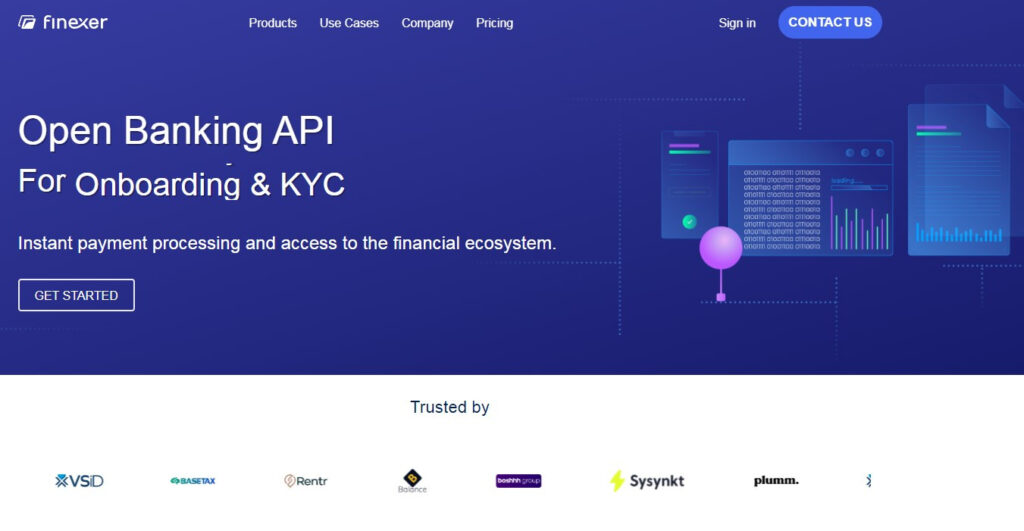
FCA registration details: Authorised by the FCA with agent licensing capabilities. Platforms can operate under Finexer’s licence rather than applying for their own.
What this Open Banking infrastructure company delivers:
- Single API covering AIS for bank transaction data and PIS for Pay by Bank payments
- Structured JSON outputs with transaction enrichment fields such as merchant identification and categorisation
- Real-time webhooks for transaction and payment events
Bank coverage: 99% of UK bank accounts. High street banks, challenger banks like Monzo and Starling, and building societies all included.
Where this unified API firm operates: London office at 124 City Road. UK focus only.
Integration approach: REST API design with a sandbox environment for testing. Finexer provides 3–5 weeks of hands-on onboarding support during implementation.
Customer evidence: Sysynkt and VSiD both published public testimonials praising Finexer’s collaborative approach and flexible commercial packages.
Backing: SFC Capital and British Business Bank.
2. TrueLayer
TrueLayer received FCA authorisation and built a platform focused heavily on payment initiation. The company also operates across Europe and Australia.
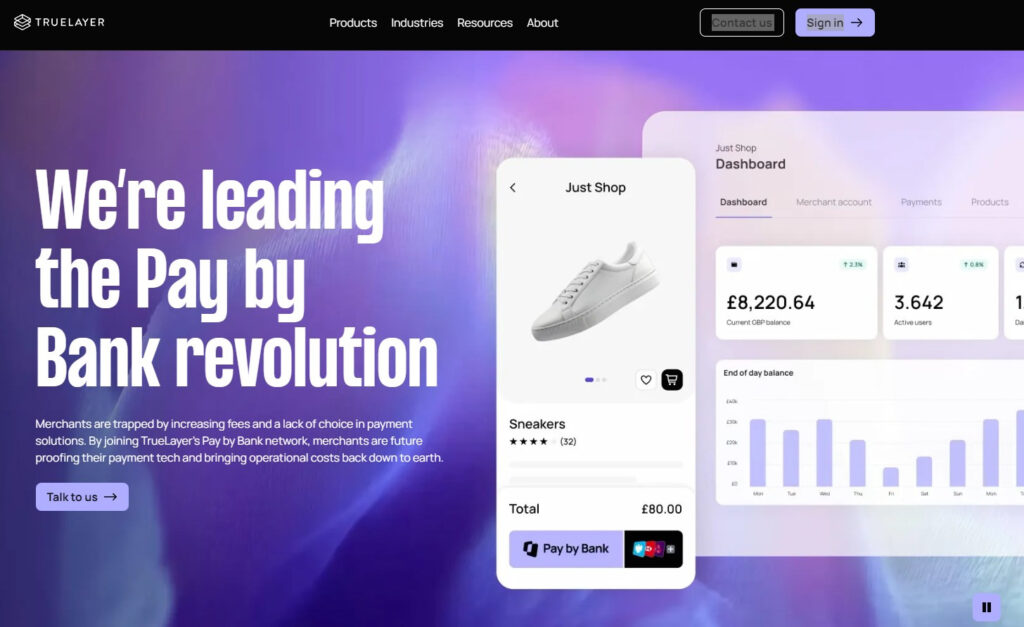
FCA compliance approach: TrueLayer implemented the FCA’s changes to the ninety-day re-authentication process through a new API called Connections. This lets platforms reconfirm user consent without forcing bank re-authentication.
For regulated AISP clients: TrueLayer pre-enabled Connections API access for regulated customers. The existing re-authentication endpoint continues working for those not ready to switch.
Certificate requirements: Platforms using TrueLayer’s regulated status do not need their own eIDAS certificates. Regulated AISP and PISP clients who hold their own licence can use their own certificates for full brand control.
What this payment initiation company does well: Pay by Bank, variable recurring payments, payouts, and refunds. Data products include account access, balances, and identity verification.
Where this FCA-authorised provider operates: UK, Europe, and Australia.
3. Yapily
Yapily holds FCA authorisation in the UK through Yapily Connect Ltd with Financial Services Register number 827001. The company also operates in the EU under the supervision of the Bank of Lithuania.
Compliance framework: Yapily describes compliance as part of how they design, operate, and scale their platform. Not a tick-box exercise. Embedded into daily operations.
Open Banking enrolment: Platforms using Yapily must apply for FCA regulation and enrol in the Open Banking Directory as an AISP or PISP. Yapily acts as the technical contact for authorisation flows.
What this open banking infrastructure company offers: Connections to over two thousand banks across nineteen European countries. Single API for AIS and PIS. Variable recurring payments available.
Who this firm serves: Payment service providers, digital banking platforms, and fintechs needing European coverage.
4. Bud
Bud is an FCA-authorised AISP operating in the UK. The company provides Open Banking aggregation services to regulated clients.
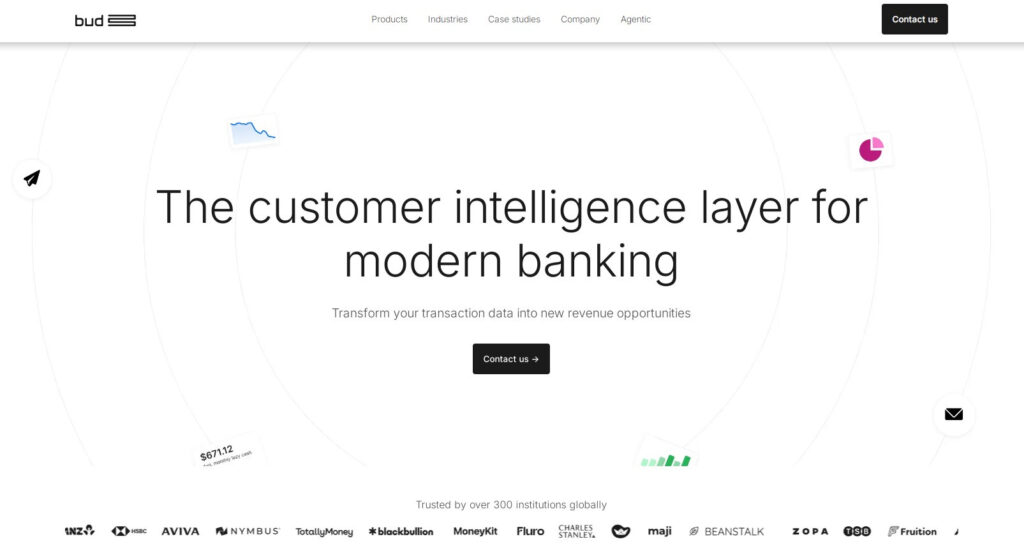
Licensing model: Bud offers two connection methods. For regulated FCA-licensed AISP clients, Bud acts as a Technical Service Provider. The client uses their own licence while Bud provides the aggregation infrastructure.
Technical documentation: Bud’s API returns providers with maintenance window and status fields. Platforms can check which banks are undergoing maintenance before attempting connections.
What this bank data company delivers: Transaction categorisation, affordability insights, and lending intelligence. The platform enriches raw bank data with merchant and spending pattern analysis.
Where this financial data firm focuses: Lending platforms, credit assessment tools, and personal finance management applications.
Regions: Primarily the UK with some European coverage.
5. Salt Edge
Salt Edge holds registration as an AISP with the UK’s FCA. The company also carries ISO 27001 certification and PCI DSS compliance.
Global footprint: Salt Edge connects to five thousand financial institutions across fifty countries. Offices in Toronto, London, Bucharest, Chisinau, and Milan. Team of over one hundred people.
Two product lines: Open Banking Gateway for data access and payment initiation. PSD2 Compliance Solution to help banks meet regulatory requirements within one month.
What this open banking gateway company provides: Transaction categorisation, merchant identification, and financial insights. Consent management system. Mobile SCA. TPP verification.
Customer base: Western Union, Société Générale, GTBank, Odoo, Doconomy, MoneyWiz, Thincats, Nova Credit .
Who this FCA-registered provider serves: Lending platforms, PFM tools, ERP systems, EMIs, banks, invoicing software, accounting platforms, and KYC providers.
6. GoCardless
GoCardless holds FCA authorisations under the Payment Services Regulations. The company also carries electronic money licences and ACPR authorisations under PSD2.

Company scale: More than eighty-five thousand businesses use GoCardless. Annual payment processing exceeds thirty-five billion dollars across thirty countries.
What this bank payment company delivers: Recurring and one-off payment collection. Direct debit alternatives. Open Banking payments through Instant Bank Pay.
Regulatory status: EMI with API-based infrastructure. Authorised to handle both stored value and payment initiation.
Where this FCA-authorised firm excels: Subscription billing, membership platforms, and any business model built on recurring collection cycles.
Integration options: API access, dashboard, or pre-built connections to over three hundred fifty partner software platforms.
What FCA Authorisation Means For Your Platform
FCA authorisation sounds impressive. Every provider on this list has it. But the type of authorisation and how you use it varies significantly.
Three models exist in the market.
Principal model. The provider holds the FCA licence. You operate as their agent. No need to apply for your own regulatory permissions. Finexer offers this through agent licensing capabilities. TrueLayer also allows clients to operate under their certificates.
Licensed AISP model. Your company holds its own FCA licence. You use the provider as a Technical Service Provider. Bud supports this model for regulated clients. Yapily requires this for certain integrations.
Hybrid model. The provider handles payment initiation under their licence. You handle data access under your own. Or vice versa. This creates regulatory complexity that most scaling platforms want to avoid.
The question every platform needs to ask: Do we want to become a regulated entity or just use someone else’s licence?
For platforms in accounting, payroll, lawtech, or property tech, adding FCA registration to your compliance burden rarely makes sense. Agent models remove that weight.
Where Each Company Stands With The FCA
Regulatory paperwork tells one story. The table below tells another.
| Company | FCA Status | Registration Details | Agent Model Available |
| Finexer | Authorised | AISP and PISP licences | Yes |
| TrueLayer | Authorised | AISP and PISP licences | Yes |
| Yapily | Authorised | Register number 827001 | No (platform needs own licence) |
| Bud | Authorised | AISP licence | No (acts as TSP for licensed clients) |
| Salt Edge | Registered AISP | Confirmed FCA registration | Not specified |
| GoCardless | Authorised | PSRs and EMI licences | No |
Those six rows show the paperwork differences. The final thoughts below tie all of this together for your specific situation.
Wrapping Up
FCA authorisation is the floor, not the ceiling. Every company on this list meets the regulatory requirements. The differences show up in how each provider applies its regulatory model across data access, payment initiation, consent journeys, and commercial support.
Finexer positions its infrastructure for UK platforms that need Open Banking capabilities without managing unnecessary regulatory and technical complexity. Its offering includes regulated access models where appropriate, published pricing tiers, a single API supporting bank data and payments, broad UK bank connectivity, and hands-on onboarding support during implementation.
TrueLayer brings payment depth and European reach. Yapily offers headless control for regulated fintechs. Bud specialises in transaction enrichment. Salt Edge connects globally across fifty countries. GoCardless dominates recurring payments.
The right FCA-authorised open banking infrastructure company depends on your regulatory appetite, your geographic focus, and whether you need data, payments, or both.
For UK scaling SaaS platforms that want one partner for everything without becoming regulated themselves, Finexer fits that description.