
Fiat to crypto and crypto to fiat conversion has become a basic layer for business operations. Treasury management depends on it. User onboarding requires it. Payouts and liquidity management rely on it. This is not just about buying crypto. It is about moving value between systems as part of regular financial workflows. Speed, cost, and stability directly affect how well these operations run. Without proper conversion infrastructure, the whole system breaks.
The market is fragmented. No universal solution exists. Companies combine multiple providers to handle different parts of the conversion flow. That creates risks such as failed transactions, delays, poor user experience, and compliance gaps. Understanding how these systems work together is critical before choosing any provider.
The core elements of conversion infrastructure include:
- Fiat entry points for user onboarding;
- Crypto exit routes back into traditional currencies;
- Payment methods and regional coverage;
- Compliance and identity verification layers;
- Settlement speed and execution reliability.
These components define how smoothly funds move between fiat and crypto in real business operations.
1. Paybis Ltd
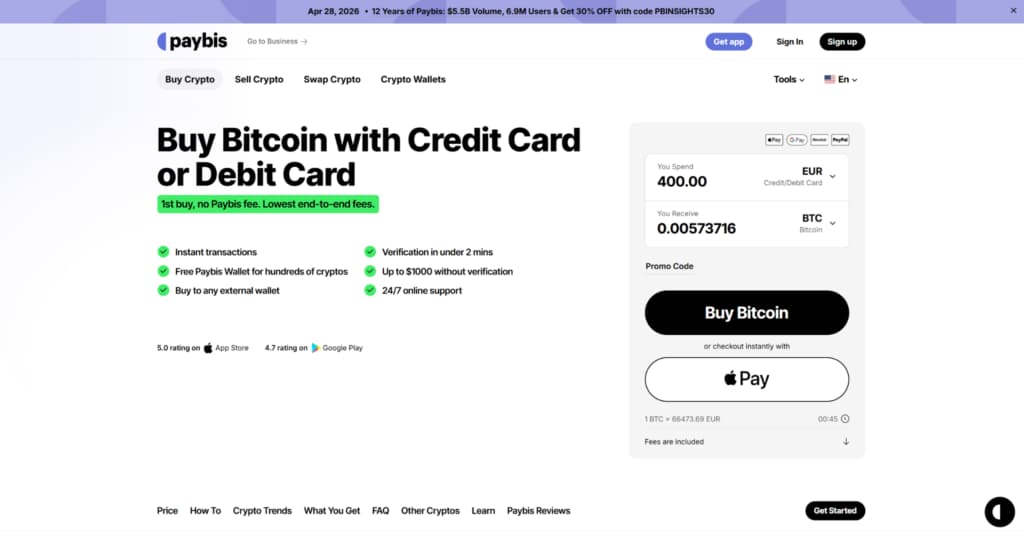
Paybis operates as a unified on-ramp and off-ramp system for businesses. The platform covers both entry into crypto and exit back to fiat within one environment. Global coverage spans 180+ countries and supports multiple payment methods across regions. This reduces the number of integrations a business needs to manage. Instead of stitching together different providers, companies can run conversion flows in one place. Complex financial operations become easier to control, track, and scale over time.
Unified Conversion Flow Without Fragmentation
Fragmented conversion flows create real operational problems. One provider handles entry, another handles exit, and funds move between them with delays. This breaks visibility and complicates reconciliation across systems. User experience also suffers when transactions fail or take too long. A unified conversion layer removes these gaps and keeps all steps within one flow. This improves execution consistency and reduces operational overhead.
Paybis supports conversion flows through:
- Fiat-to-crypto onboarding across global markets;
- Crypto-to-fiat withdrawal with flexible settlement;
- Multi-currency support with various payment methods;
- Integrated wallets for fund storage and routing;
- Execution across different business scenarios.
This setup works best for companies that want to keep conversion logic inside one system.
2. Alchemy Pay

Alchemy Pay acts as a global bridge between fiat and crypto systems. The platform focuses on enabling access through local payment methods across different regions. Availability of these methods directly affects conversion performance in each market. Alchemy Pay fills gaps where other providers do not operate or lack coverage. It plays a key role in connecting traditional financial systems with digital asset environments. This makes it useful for businesses targeting international users with diverse payment preferences.
Local Payment Access for Global Conversion
Conversion performance depends heavily on local payment availability. Global-only solutions often fail to match regional user expectations. People are more likely to complete transactions when familiar methods are supported. Alchemy Pay adapts to these differences by integrating local rails into its system. This improves completion rates and reduces friction at the onboarding stage. As a result, businesses can expand into new markets without rebuilding their conversion logic.
Alchemy Pay enables conversion through:
- Support for local and global payment methods;
- Fiat-to-crypto onboarding across regions;
- Crypto off-ramp capabilities;
- Integration with Web3 applications;
- Coverage across multiple jurisdictions.
This makes it suitable for businesses targeting global audiences with local payment needs.
3. Sardine

Sardine is built around one problem: onboarding that does not fall apart under fraud pressure. Instead of treating risk as a separate layer, it sits inside the flow from the start. This helps keep approval rates high without opening the door to abuse. Teams in fintech and neobanks lean on it when card payments and identity checks start causing friction. The system reacts in real time, not after something goes wrong. It is less about adding features and more about keeping the flow stable when things get messy.
Risk-Controlled Conversion Layer
Fraud is one of the main challenges in on-ramp conversion. Too much friction reduces approval rates and hurts growth. Too little control increases financial risk and chargebacks. Sardine addresses this by applying real-time risk scoring to each transaction. This allows decisions to be made dynamically without blocking legitimate users. The result is a more stable onboarding process with fewer failed transactions. Businesses get both protection and consistent conversion performance.
Sardine structures conversion around:
- Fraud detection and risk scoring systems;
- Fiat-to-crypto onboarding infrastructure;
- High approval rate optimization;
- Compliance and identity verification;
- Integration with fintech products.
This approach works for teams that need both security and stable onboarding performance.
4. Wyre

Wyre provides developer-first infrastructure for fiat-to-crypto conversion. The platform is designed to integrate quickly into wallets, apps, and digital products. Instead of offering complex systems, Wyre focuses on simplicity and speed. This allows teams to launch conversion functionality without long development cycles. Many Web3 products use it to enable embedded crypto features. The approach prioritizes fast deployment and minimal friction for developers.
Fast Integration for Embedded Conversion
Time to market is a key factor for many products. Long integration processes delay launches and increase costs. Wyre reduces this barrier by offering simple APIs and clear documentation. Developers can connect conversion flows directly into their applications. This makes it easier to test, iterate, and scale features over time. A streamlined integration process also reduces engineering overhead. As a result, teams can focus on product growth instead of infrastructure.
Wyre supports conversion through:
- API-based fiat-to-crypto onboarding;
- Quick integration into apps and wallets;
- Support for embedded crypto features;
- Basic off-ramp functionality;
- Developer-focused infrastructure.
This makes it a good fit for teams building crypto features directly into their products.
5. Coinify

Coinify is built for companies that need to move between fiat and crypto without running into regulatory problems later. It works closely with banking infrastructure, so flows don’t feel disconnected or stitched together. Everything runs inside clear compliance boundaries, which limits flexibility but removes a lot of uncertainty. You don’t get the fastest rollout, but you avoid surprises when volume grows or regulators step in. The process around onboarding and settlement is structured from the start, not patched later. That is why it is usually picked by teams that value predictability over speed.
Regulated Conversion for European Markets
Regulation plays a major role in financial operations involving crypto. Without proper licensing, providers face restrictions or shutdowns. Coinify operates within established EU regulatory frameworks. This allows businesses to process transactions without legal uncertainty. Compliance processes such as KYC and AML are built into the system. This ensures that conversion flows meet required standards. For companies operating in Europe, this reduces operational and legal risks significantly.
Coinify enables conversion through:
- Fiat-to-crypto onboarding in regulated markets;
- Crypto-to-fiat settlement with compliance;
- Integration with banking systems;
- Support for multiple payment methods;
- Operations aligned with EU regulations.
This setup works best for companies operating in regulated financial environments.
How to Choose the Right Conversion Provider
Choosing a conversion provider starts with understanding how money actually moves through your system. Different businesses have different flows, such as onboarding, treasury, payouts, or internal transfers. A provider that works well for one case may fail in another. The goal is not to find the most feature-rich option but the one that fits your operational model. Integration complexity, geographic coverage, and compliance requirements all affect performance. Poor selection leads to hidden costs and constant workarounds.
Several factors define how well a provider performs under real conditions. These are not always visible in demos. Real performance appears under load, across regions, and during edge cases. To make a practical decision, focus on the following:
Core factors to evaluate include:
- Support for both fiat-to-crypto and crypto-to-fiat flows;
- Geographic coverage and local payment method availability;
- Integration complexity and developer resources required;
- Compliance and regulatory alignment in your target markets;
- Transaction success rate and settlement speed.
A provider should be evaluated based on how it performs across these dimensions in real scenarios. Choosing the right setup reduces operational friction and improves scalability.
Final Thoughts
Conversion is no longer an add-on. It sits right in the middle of how businesses move money today. There is no single provider that covers every scenario cleanly, so most setups are still mixed. The real difference shows up when volume increases, and things start breaking. Some systems hold up, others don’t. Priorities vary, but execution always matters more than feature lists. The only reliable way to judge a setup is to see how it behaves under real pressure, not in a controlled demo.