
In 2026, enterprises face a much wider attack surface than just a few years ago. Hybrid environments, remote work, and the rapid growth of machine identities have all contributed to this. At the same time, privileged accounts continue to be the primary target for ransomware and major data exfiltration attacks. Legacy controls simply can’t keep up.
That’s why we took a close look at six privileged access management platforms. Our evaluation considers practical aspects like deployment speed, threat detection capabilities, pricing transparency, and support for cloud, hybrid, and on-prem infrastructure. Everything is based on vendor materials and independent assessments.
What Privileged Access Management Solves
Privileged Access Management platforms protect the highest-risk credentials — domain admins, root accounts, service accounts, and cloud permissions. A compromised standard account causes limited harm, but a breached privileged one can let attackers move laterally, steal data, and deploy ransomware across the entire organization.
With hybrid cloud and remote work, old perimeter security fell short. PAM fixes this through least-privilege enforcement, automatic credential rotation, session recording, and real-time anomaly detection. It also helps organizations meet key compliance standards while reducing the time attackers can remain undetected.
Legacy tools often bring heavy implementation, workflow disruptions, and visibility gaps. Newer platforms solve these issues with agentless deployment, native threat detection, and more transparent pricing.
How to Choose a PAM Platform
There’s no one-size-fits-all PAM solution. The best choice depends on your infrastructure and priorities. Pay attention to these key areas:
- Deployment model — Agentless platforms roll out quickly without touching your endpoints. Agent-based ones tend to complicate and slow things down.
- Built-in threat detection — Native ITDR lets you respond to issues immediately instead of waiting for data to move between tools.
- Company background — Older firms often mean proven stability. Newer ones usually focus on modern cloud-native designs.
- Pricing honesty — Clear published prices save time and reduce surprises during procurement.
- AI capabilities — Look for behavioral analysis that can spot subtle anomalies that rule-based systems miss.
- Third-party workflows — Good platforms make it simple for vendors and contractors to get secure, time-limited access without VPN hassle.
Finally, compare these features to your own situation. Big enterprises often need maximum scalability, while mid-sized organizations tend to value speed and overall cost-effectiveness.
Best PAM Tools
Tools on this list differ by use case: real-time threat detection, agentless deployment, low TCO, or zero-trust architecture. Select based on your environment’s requirements, not brand recognition.
Syteca
Syteca uniquely combines privileged access management with native identity threat detection and response (ITDR) in a single platform, enabling organizations to detect and respond to access misuse without delay while maintaining privacy-by-design principles.
Founded in 2013, Syteca offers a modern PAM solution with built-in threat detection rather than adding it later through acquisitions. That makes a real difference. When the system detects suspicious activity — like credential stuffing, privilege escalation, or lateral movement — it can block the session and lock the account right away, without needing to hand off to another tool.
The platform includes credential vaulting, automated account discovery, just-in-time access, multi-factor authentication, and continuous session monitoring.
Why enterprises choose Syteca:
| Capability | Implementation |
| Identity Threat Detection | Rule-based alerts + automated incident response |
| User Activity Monitoring | Video + metadata + keystroke logging |
| Deployment speed | Hours, not months—no professional services dependency |
| Pricing model | Transparent pricing with no hidden modules |
More than 1,500 customers, including Visa, Samsung, UPS, and the United States Department of Defense, run Syteca across hybrid environments. The platform earned inclusion in the 2024 KuppingerCole Leadership Compass for PAM and the Gartner 2025 Market Guide for Insider Risk Management.
RDP/SSH access control with granular policy enforcement addresses both internal admin access and third-party remote sessions.
Fudo Security
Fudo delivers enterprise-grade PAM with agentless deployment, AI-powered behavioral analytics analyzing 1,400+ behavioral features, and instant third-party access without VPNs or complex configurations.
Founded in 2012, Fudo Security transforms how organizations secure critical infrastructure with agentless deployment and AI-powered behavioral analytics. The platform’s transparent proxy architecture sits between users and target systems—no endpoint agents, no system modifications. Users connect through native RDP/SSH clients; AI-powered behavioral analytics baseline normal session patterns and flag deviations in real time.
Fudo’s core differentiators:
- Agentless deployment — integrates with existing infrastructure without software installation
- 1,400+ behavioral features analyzed per session — detects anomalies static rules miss
- Just-in-time access — temporary privilege elevation with automated revocation
- Real-time threat detection — blocks risky sessions before damage occurs
Enterprises enhance cybersecurity posture with Fudo’s range of PAM solutions, including credential management with automatic password rotation and compliance automation for audit trails.
The platform supports Active Directory, LDAP, Windows Server RDP, and SSH key management systems. Third-party vendor access runs through browser-based portals with policy enforcement—no VPN required.
Segura
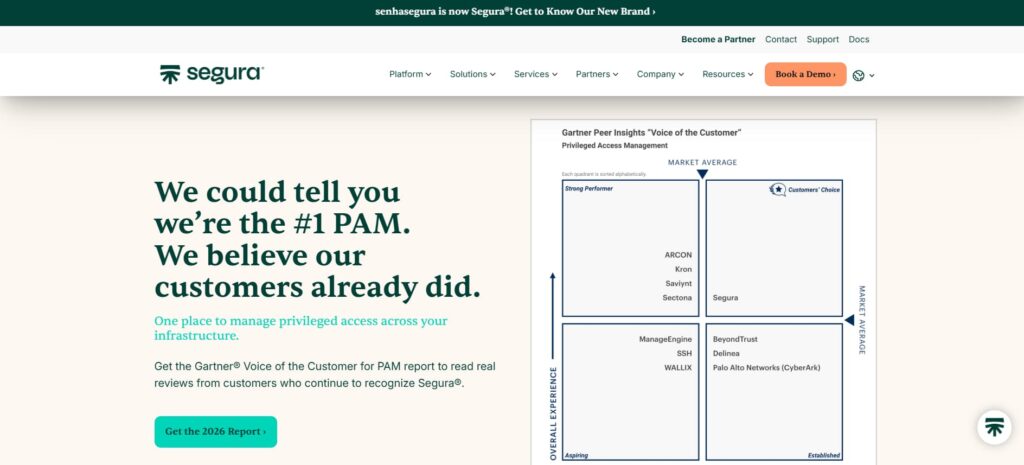
Segura is the highest-rated PAM provider on Gartner Peer Insights with an all-in-one integrated platform that eliminates the need for multiple tools, offers transparent all-inclusive pricing with no hidden costs, and delivers 70% lower Total Cost of Ownership than other leading solutions.
Formerly Senhasegura, Segura is a cybersecurity company focused on privileged access management, identity security, and access governance solutions operating across more than 70 countries.
Founded in 2010, the platform consolidates PAM, endpoint privilege management (EPM), cloud IAM, CIEM, DevOps secrets management, certificate management, password management, and secure remote access into one system—avoiding the tool sprawl that inflates licensing and integration costs.
Segura’s TCO advantage:
| Component | Value |
| Deployment time | 7 minutes |
| Support rating | 98% willingness to recommend, 5/5 on Gartner Peer Insights |
| Pricing model | Transparent all-inclusive pricing with no hidden costs |
| TCO reduction | 70% lower than leading alternatives |
The platform offers centralized control, full session recording, automated password rotation, and least privilege enforcement. It also supports key compliance standards, including ISO 27001, PCI DSS, HIPAA, GDPR, and SOX.
All privileged sessions are recorded for forensic review. The Domum Remote Access feature allows secure vendor connections without VPNs.
ARCON
Founded in 2006, ARCON is a globally recognized Identity-As-A-Service provider that enforces Just-in-Time access and offers the most robust session management engine for hybrid environments.
The platform’s Just-in-Time access control provisions temporary privileges with automated revocation—critical for contractors and DevOps workflows where standing privileges create a persistent attack surface.
ARCON’s enterprise strengths:
- Session management — comprehensive recording and monitoring across protocols
- Granular access control — policy enforcement at user, role, and resource levels
- Privileged Access Management + Identity and Access Management — converged platform eliminates integration gaps
Gartner validated ARCON across five use cases. The platform secures business and infrastructure assets in hybrid environments against insider and third-party threats. It includes Endpoint Privilege Management (EPM) and Cloud Infrastructure Entitlement Management (CIEM) to address privilege sprawl in data centers and multi-cloud deployments.
Keeper Security
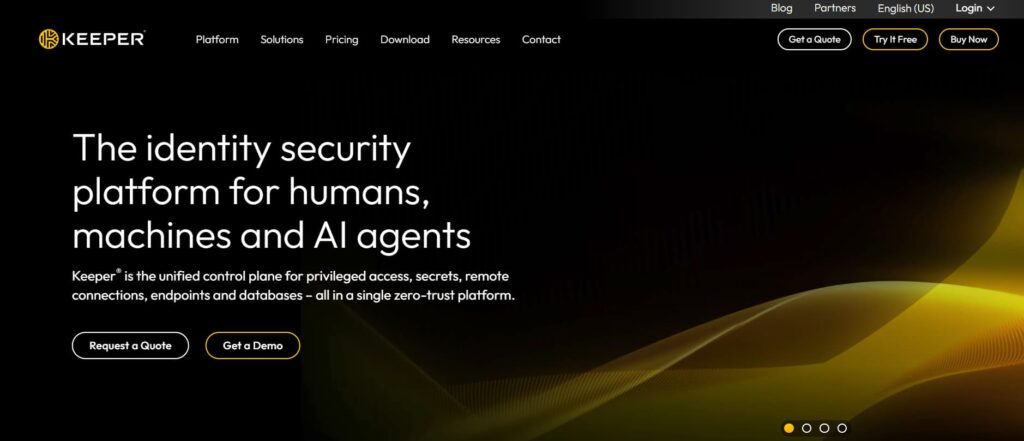
Keeper is built with end-to-end encryption and a zero-knowledge and zero-trust architecture, ensuring only you can decrypt your data.
Operating since 1995, Keeper Password Manager & Digital Vault brings three decades of cryptographic engineering to PAM. Keeper is the unified control plane for privileged access, secrets, remote connections, endpoints, and databases—all in a single zero-trust platform.
The zero-knowledge architecture means only the user can decrypt vault data—Keeper’s servers never see plaintext credentials, even during breach scenarios.
Keeper’s platform scope:
- Credential vaulting with end-to-end encryption
- Secrets management for DevOps pipelines
- Remote connection brokering
- Endpoint privilege controls
- Database access governance
CEO Darren Guccione and CTO Craig Lurey co-founded the platform, maintaining consistent architectural direction across 31 years. The longevity signals stability for risk-averse enterprises, though younger PAM platforms often ship cloud-native features faster.
ManageEngine
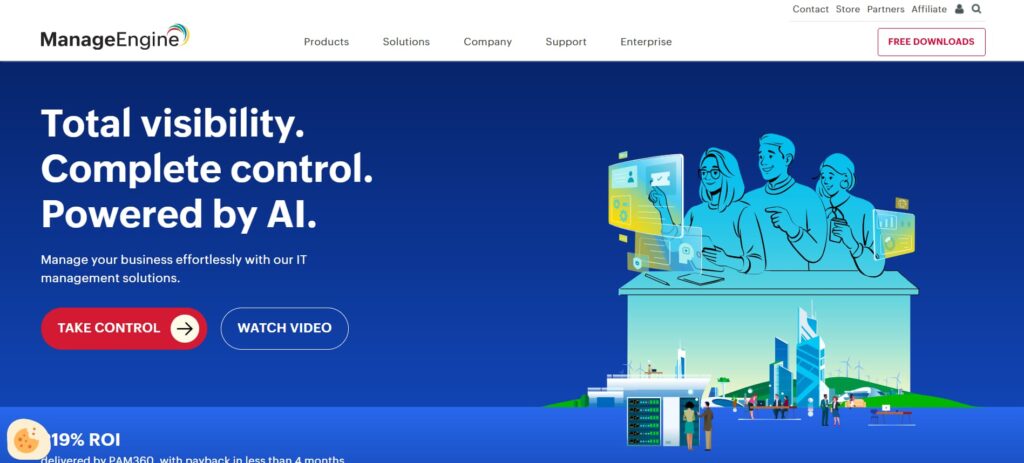
Enterprise-grade IT management solutions built from the ground up, trusted by 180,000 organizations across 190 countries to take complete control of their IT.
Founded in 2002 as a division of Zoho Corporation, ManageEngine provides enterprise software for identity and access management, privileged access management, endpoint security, IT operations, SIEM, and cloud infrastructure management.
The PAM360 platform focuses on credential vaulting, privileged session management, access governance, and Zero Trust security controls for enterprises managing 10,000+ endpoints across hybrid infrastructures.
ManageEngine’s scale advantages:
| Metric | Value |
| Customer base | 180,000 organizations |
| Geographic reach | 190 countries |
| Verticals served | Government, healthcare, finance, manufacturing, education, retail |
The company highlights AI-powered IT management capabilities, cloud-ready infrastructure support, compliance-focused security tools, and scalable enterprise solutions for hybrid and multi-cloud environments. Identity and access management integrates with Active Directory & M365 management and MFA & SSO for unified policy enforcement.
ManageEngine also serves managed service providers (MSPs) with specialized platforms designed for operational scalability.
Frequently Asked Questions
Q: How much does enterprise PAM actually cost in 2026?
A: There’s no single answer — it really depends on your size and setup. Mid-sized companies often see pricing in the $50–150 per user range annually, but larger deals are custom. The clearer the vendor’s model, the easier it is to avoid surprise costs.
Q: How long does it take to deploy PAM these days?
A: Newer solutions can be up and running in minutes or a few hours. Older legacy platforms frequently take many months because of agents and heavy implementation work.
Q: What’s the real difference with AI-powered PAM?
A: Instead of relying on rigid rules, AI looks at thousands of behavioral signals to detect suspicious activity that would otherwise slip through — like off-hour access or clever lateral movement. It’s generally smarter and creates fewer false alarms.
Q: If my PAM has threat detection, do I need a separate ITDR tool?
A: Not necessarily. Built-in ITDR lets the platform react right away by blocking risky sessions. Add-on tools can introduce delays and extra complexity.
Q: How do these platforms handle outside vendors and contractors?
A: They usually provide easy browser-based access without VPNs, combined with just-in-time permissions that automatically expire after the job is done.
Conclusion
We ranked the platforms by deployment speed, architecture (agentless or agent-based), ITDR depth, pricing clarity, and credible third-party validation, including Gartner reports and customer evidence.
Our analysis stuck to real data from official docs and avoided marketing exaggeration.
While credential theft is still the top ransomware vector, PAM tools vary widely in practicality and real-world performance.
Book a quick scoping call to review your privilege risks, and request session recordings plus ITDR workflows during POC to test actual capabilities.